Bristol History Commission – questions still not answered….

By Randell Brantley
On 4th August Bristol Radical History Group sent a letter supported by the Remembering the Real World War One history group and Countering-Colston to the Mayor’s office concerning the Bristol History Commission (HC) which was set up by the elected Mayor Marvin Rees in response to the statue of Edward Colston being pulled down on 7th June. In the interests of transparency in the public domain and in the light of other recently failed projects the letter asked the Mayor for systematic answers to […]

Bristol History Commission – some questions….

By Randell Brantley
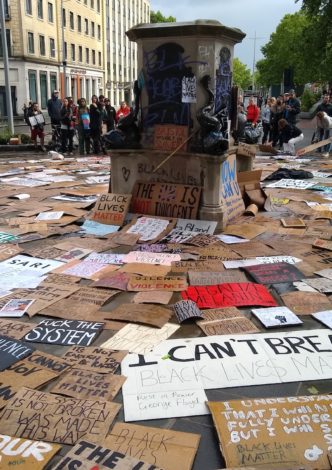
In the aftermath of the pulling down of the statue of slave-trader Edward Colston on 7th June, elected Mayor Marvin Rees announced the formation of a 'History Commission' to "help us tell our full city history" and to "shape the future of Bristol". Since the announcement we have waited for some clarity about the Commission, its members, processes, timescales and remit but none have appeared. Several people have asked questions of the Mayor's Office but received no answers (as yet). As Bristol […]
Colston slept with the fishes

By Randell Brantley
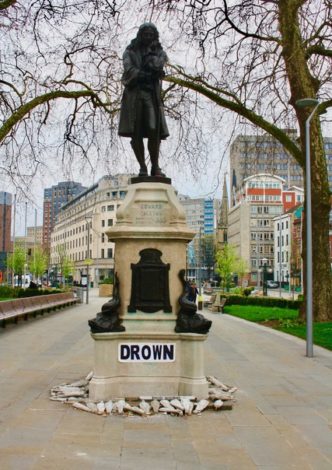
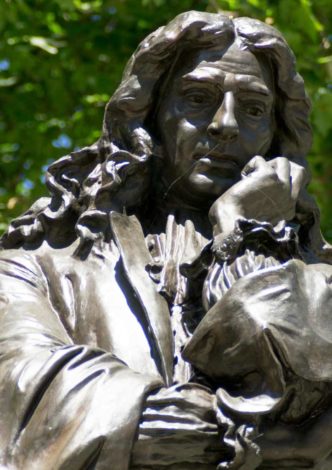
In April 2019 The Saint-Just Mob subverted the statue of Edward Colston with the word DROWN. The following article first appeared on the BRHG Facebook page in the same month. Republishing it here seems apposite as he slept with the fishes for a few days at the bottom of the very docks where slave ships bound for Africa would have moored and now skulks in the basement of M Shed. The statues of Samuel Plimsoll and Edward Colston stand within half a mile of each other and share one thing in common […]

Who owns Colston?

A silent clause When Edward Colston died in 1721 we can be fairly certain that before long his body had disintegrated into dust. To talk of Colston, therefore, is meaningless unless we recognise that our knowledge of that long dead figure will always be dependant upon how we read, interpret and understand the historical record which is made up of histories, biographies, memoirs, documents, images, statues and artefacts. And because most of the historical record was created, constructed, produced […]

Lydney: Black Lives Matter and the Bathursts

By Randell Brantley
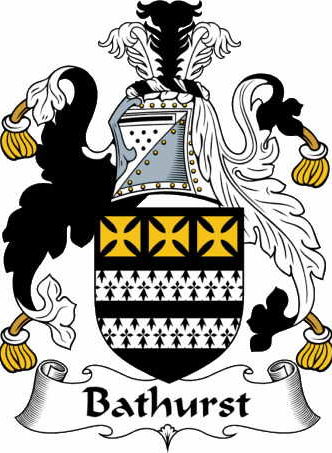
1754 – 1831 Lydney Town Council has attempted to ban a Black Lives Matter event arranged to take place in Bathurst Park, Lydney at 2 pm – 4 pm Saturday 20 June. Forest of Dean Black Lives Matter has issued a statement on their Facebook Page which includes the following: We cannot continue to allow this oppression in our society; the primary purpose of this event to begin with was to challenge this and to encourage change, it is sad that you have prevented from us doing so. We do not wish to, and […]

Kick over the statues….Colston is going…going…gone

By Randell Brantley
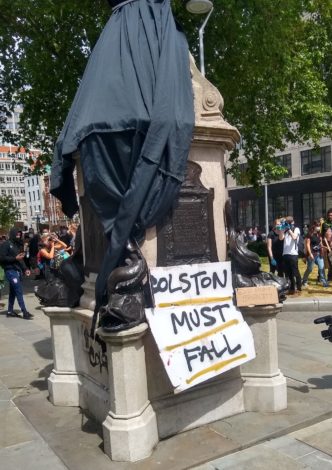
Over the last few years in arguments over the commemoration, celebration and memorialisation of slaver-traders we have been told many times that the so-called 'traditions' of Bristol must be protected. That is code for not changing anything; names of buildings, schools and statues, which are all part of the memorial landscape of Bristol created over the last couple of centuries largely by the merchant and business elite. Well, there is another great historical tradition in Bristol, that is […]

From Wulfstan to Colston

Severing the sinews of slavery in Bristol

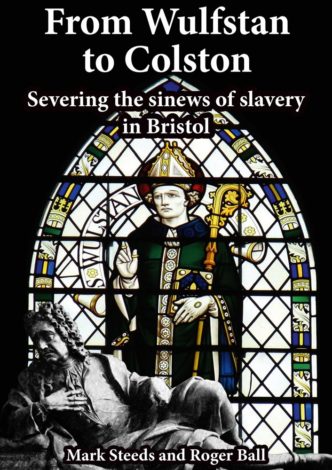
Tracing a thousand-year history, Mark Steeds and Roger Ball examine the involvement in slavery of Bristol’s merchants, from Anglo-Saxon times through the era of exploration and colonisation, to the transatlantic slave trade and the plantation system of the Americas. During this period, Bristol’s merchant elite seized economic and political power, making slave-trader Edward Colston an icon and shaping the city’s present-day historical memory of slavery. Throughout the millennium, determined […]

The Apocalypse of Settler Colonialism: The Roots of Slavery, White Supremacy, and Capitalism in Seventeenth Century North America and The Caribbean

By Gerald Horne
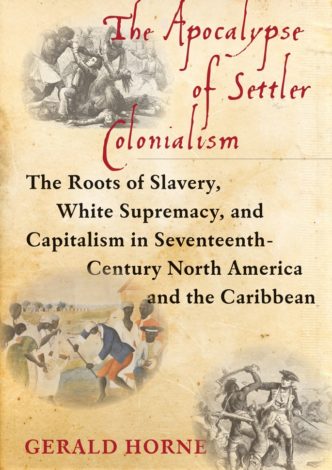
As you will have probably gathered from the title, Professor Gerald Horne wastes no time with mincing his words. The first paragraph of the Introduction is likewise refreshingly uncompromising about the position that the book takes: The years between 1603 and 1714 were perhaps the most decisive in English history. At the onset of the seventeenth century, the sceptered isle was a second-class power but the Great Britain that emerged at the beginning of the eighteenth century was, in many ways, […]

Update – Brecon plaque commemorates slave trader

Should society memorialise a slave trader?

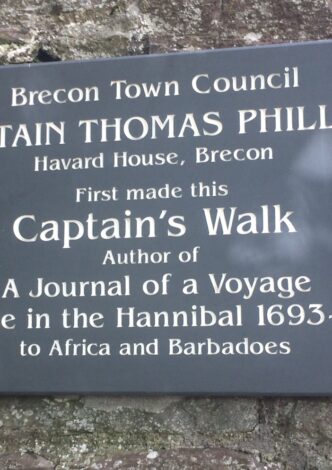
In the Welsh town of Brecon, upon an old wall, along Captains Walk (a name based on a fiction), is a slate plaque commemorating the life of a slave trader who resided in the town. The plaque was commissioned by Brecon Town Councillors in 2009, erected in October 2010 (during Black History Month), and makes no reference to the fact that Captain Phillips was a 17th century slaver. Captain Thomas Phillips was the commander of the infamous slave ship the Hannibal in the 1690s. He was directly […]

Nautical Women – Women Sailors in History

By invitation of Pill Library and Children's Centre Crockerne House, Underbanks, Pill, BS20 0AT Wednesday, 19 February 2020 @ 2pm Author Rosemary Caldicott will be telling us about her book in which she investigated the intriguing histories of nautical women. These include stories of cross-dressing women who went to sea to earn a living and the mad, tragic and often funny consequences they encountered and endured. Living in or near Bristol, we’re all quite familiar with images of sailing ships – […]