Book review
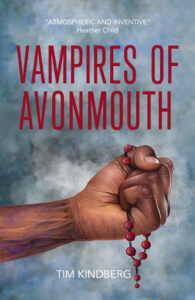
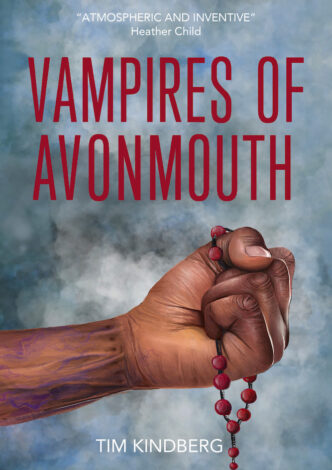
What is lurking near the end of the grand pier with its wisht presence? Anyone who has taken a cursory glance at a field guide to the natural history of the vampire will know that there are vampires of blood, and other species hungry to feed upon the psyche. Those that inhabit the irresistibly titled Vampires of Avonmouth are the latter. Set in the late twenty-first century West Country and Ghana, the novel follows the efforts of the chief protagonists, rogue ID cop, David, tracking “renegades”, and the Ghanaian Pempansie, named after an Adinkra symbol of foresight and resilience. The relationship between the two is forged in a shared yearning to free their bodies and minds of their vodus, seemingly alter-beings that have entered them and dwell within. These, perhaps, are malevolent versions of those integrally connected dæmons familiar from their co-habitation of Phillip Pullman’s characters. This is a world animated by “mentalmagic” and populated by fleshren (humans), quasi-sentient, shapeshifting robots called bodais, electro-sorcerers and a dog called Coleridge. And, of course, there is the vampiric Obayifa, an attractive but menacing psychic predator, who unaccountably arrives on a rusting hulk of a ship. A haunting presence for the duration of the novel, Obayifa is more chilling than the common or garden sanguivorous vampire. Will she get her sustenance?
Like all good histories of the future, this novel extrapolates present trends into their fuller manifestation. After the time of “the Disruption,” (illegal to mention) trajectories of technological determinism have intensified. Artificial intelligence is a dominant controlling force, there has been a pandemic in the form of a dementia plague and bytecoins are in circulation. Errant Big Tech overlord’s increasingly condition present-day technologies from investment through research and development to their implementation, distribution and supply so that they are channelled to their interests and saturated with their ideologies. Here, the power of the undisclosed Big Mind is the controlling power. In this risky and uncertain reality, identity is a currency and David bends the rules of what is acceptable to IANI (the supreme authority) in his pursuit of ID criminals. Most controversially he even periodically goes offline, a deeply suspicious and questionable activity. A misfit who breaks with his assigned role, David is a sci-fi noir character, recalling the desperate anti-heroes of Philip K. Dick and William Gibson. Readers quickly find ourselves in a dystopian class society, where the unfortunate victims of vampirism are “nonned” into a zombie-like state:
Unresponsive, void-staring husks of human beings climbed into the branches instinctively and tottered until, finally weakened, they fell like empty, wing-clipped angels into the Accra-city streets.
Agency is a privilege of the digitally well-endowed. The wealthy inhabit communities that are more firewalled than gated, enjoying a state of “virtual segregation” a kind of class apartheid secured by algorithms. Others live in the realm of the “down-below”, fed “sensa” through mechanisms of telepathic domination so that a state of “numbed peace” prevails. For most of society, therefore, history has ended in perpetual social sedation. As one character scoffs, with a nod to Fukuyama, “I thought history ended decades ago”.
If the world of Vampires of Avonmouth for the most part exists outside time, much of it is also an atopia, a non-place where local distinctiveness has been erased. Only in pockets of “down-below” do differentiated streets and parishes of the eponymous Avonmouth endure in folk memory:
The city’s regions were but topological contingences of the built environment, without individual character. And yet flesh sometimes referred to parts of the down-below with the names of streets as used to be: Merebank, Kings Weston, Ironchurch.
There are some familiar place names such as Arnos Vale, but this is not recognisably the West Country as we know and love it. Now a hub, Avonmouth.city, has become the main centre of settlement, cheekily eclipsing Bristol.city which:
Lay drab and dilapidated, unrecognisable from its days as a centre of creativity and technology early in the century. Now it was little more than a collection of cemeteries. They left the uninhabited suburbs, soaring above the fleeting landscape. The Avon, with its crinkly mud walls at low tide, snaked back to the Severn Estuary beside them.
Beloved cultural institutions that help create a sense of place have lost their purpose and disappeared “… there were no longer any parks, gardens, galleries or museums, since those could be experienced virtually, telepathically via sensa delivered at optimum times.”
Tim Kindberg has more fun with “Super Mare”, which is somewhat legendary location, at turns the end of the rainbow and an El Dorado in the popular imagination. “Not on any map”, for much of the novel the characters are unsure as to whether it actually exists. It is also apparently protected by a field of repulsion that ensures outsiders rarely visit.
Cities are typically hubs with domain-names, signalling that the distinction between the physical, organic world and virtual world has largely blurred and collapsed. The physical world of the post-Disruption has clearly suffered from traumatic ecological crises. Despite the installation of solar panels and wind turbines, urban dwellers live in fear of rising sea levels and migration, as presumably large swathes of the planet have become uninhabitable. Echoing the concerns of David Goulson’ Silent Earth, this is also a post-insect land. It is unclear how crops might be pollinated. Indeed, not much eating or drinking occurs in the novel, even on the part of the characters who are flesh. An exception is David’s consumption of an “unmeatburger” in Spoons, the eateries that have somehow survived like corporate cockroaches. As David breaks away to a freer life an unexpected experience of biophilia in a garden of fragrant flowers and embracing trees is a moment of therapeutic liberation. However, both he, and we readers, are left uncertain as to whether this green place of beauty is authentic.
Kindberg’s expertise in computer science enables him to conjure a complex other world that is convincing, if bewildering, in its detail. It evokes an alienating future technosphere where digital identity is both a refuge and a vulnerability, and where there is no religion but “the worship of consumption”. In this context, memory is a form of resistance; even David is unsettled by the unnamed notepad and pen-wielding heretic, his cellmate who speaks of the forbidden times of football, skateboards, and bicycles. Vampires of Avonmouth has pace and momentum. It is recommended reading for all West Country sci-fi fans and for those with a taste for speculative history. Future Song, Kindberg’s new novel forthcoming at the time of writing, is also set in a West Country of impending decades, beset by climate change. It will be one to look forward to and to listen out for.
Book review by Stephen E. Hunt.