
Slavery - The Hidden History
- Read the programme and find out about the events
- See the publicity material (posters, flyers etc.)
- See the Slavery, Resistance & Rebellion gallery
These events where held between 4th and 15th March 2007
Click the red links for more details of each event and venue.
| Date | Time | Form | Title | Notes | Venue |
| Sun. 4th March | 11:00am | Walk | Black and Blue: The Social History of Bristol Glass |
With Jim McNeil | — |
| Tue. 6th March | 2:00pm | View | Opening The Archives: The Abolitionist Movement in Bristol |
View primary source material | BCL |
| Tue. 6th March | 8:00pm | Film | La Ultima Cena | A Cuban Film by Tomás Gutiérrez Alea | The Cube |
| Wed. 7th March | 7:30pm | Lec. | Scandal! The Slave Profiteers | With Jim McNeil | Kuumba |
| Thu. 8th March | 7:30pm | Lec. | The Invisible Abolitionists & The Slaves Who Abolished Slavery |
With Adam Hochschild & Richard Hart | The Cube |
| Fri. 9th March | 6:00pm | Pub. | Bristol Abolitionist Pub Night at The Seven Stars |
With Mark Steeds | Seven Stars |
| Wed. 14th March | 8:00pm | Lec. | Caribbean Struggles After Abolition | With Richard Hart | Kuumba |
| Thu. 15th March | 7:30pm | L/D Soc. |
Black Radical Abolitionists | South London Radical History Group | The Cube |
Abbreviations: Walk = History Walking Tour, Lec. = Lecture, L/D = Lecture/Debate, Pub. = Pub Night, Soc. = Social, View = Public Veiwing, BCL = Brisrol Central Library. |
|||||
March 2007 was the 200th anniversary of the parliamentary abolition of the slave trade in the British Empire. The 'celebration' of the abolition was controversial for several reasons. As a school children we were taught that William Wilberforce was the 'conscience of the nation' reforming the worst excesses of the Empire for the benefit of all. We were taught nothing of the politics, economics or military aspects of the trade in human flesh that filled both the coffers of the British ruling class and stimulated industrial capitalism. As for the slaves themselves they hardly entered the debate and if they did it was only as cowed, brutalised victims in shackles on crowded ships. There are reasons why this history was taught to us like this, why we know who Wilberforce is, why we don't know who Thomas Clarkson, Olaudah Equiano and Samuel Sharpe are and why our city still celebrates the slave traders with statues and by and large refuses to acknowledge either the slaves or the abolitionists.
In May 2006 year a debate was held in Bristol between a group of intellectuals and academics concerning the question 'should Bristol apologise for slavery'. The next evening HTV news reported the event and the result of a poll of the audience showing 90% in favour of an apology by 'Bristol'. HTV gleefully replied with their own street poll of 'ordinary Bristolians' that showed 90% were against an apology. Many respondents said quite rightly 'why should I apologise, what have I got to do with it now?'.
The only physical thing that lives on from the millions of hours of forced labour of the slaves is the land and property purchased by the organisers and instigators of the plantation/slave system. The descendents of these slave-trading families are still benefiting from this. At the time Bristolians were not equal in either their complicity or the benefits they received from the trade. Many were themselves trapped in forced labour whether as impressed sailors, transported criminals, indentured servants or simply economically in the bondage of wage labour. In any case only 5% of the male adult population had the vote. So clearly not everybody was equally responsible. So who should be apologising for what? Of course, if the question had been 'Should the Society of Merchant Venturers apologise for slavery?' there would probably be a quite different response. It's about time we challenged the idea that all Bristolians were equal in their complicity.
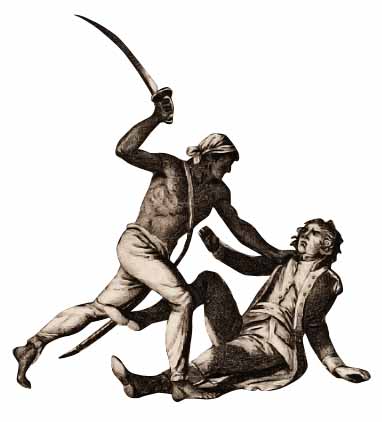
Bristol Radical History group planned a programme of events to both mark and critique the occasion.
- The Slaves Who Abolished Slavery: the impact of the numerous slave revolts in the Caribbean on the end of the slave trade and slavery itself.
- The 'British' History Of The Abolition: the politics of the 'official' history of slavery and its abolition.
- The Black Radical Abolitionists: A new reading of Olaudah Equiano's 'Interesting Narrative' and discovering black revolutionaries of the British abolitionist movement.
- Bristol And The Plantation/Slave System: Discover the links between the vast profits made by slave owning families and the rise of industry in Bristol.
We also hosted some films, history walks and a gig or two as well.
Scandal! The Slave Profiteers
- Details
- Date: Wednesday 7th March
Time: 7:30pm - Venue
- Kuumba
- Price
- Donation
- Speaker
- Jim McNeill: local historian, storyteller and member of Living Easton.
Jim McNeill's contribution concentrated on how the Emancipation Act of 1833 awarded Bristol-based slave owners compensation of over £500,000 for the 'loss' of their slaves. Jim looked at how this money was invested to stimulate the establishment and growth of industrial development, including Gas, Cotton and Railways in the city.
- Listen to this lecture Pt. 1
- Listen to this lecture Pt. 2
- See a pdf file containing the power point slides for this lecture
The Merchant Venturers Building
at The University of Bristol.

The Invisible Abolitionists and The Slaves Who Abolished Slavery
- Details
- Date: Thursday 8th March
Time: 7:30pm - Venue
- The Cube
- Price
- £2
- Speakers
- Adam Hochschild: A multi-award winning author, his first book Half the Way Home: a Memoir of Father and Son, was published in 1986. It was followed by The Mirror at Midnight: a South African Journey, The Unquiet Ghost: Russians Remember Stalin, Finding the Trapdoor: Essays, Portraits, Travels, King Leopold's Ghost: a Story of Greed, Terror and Heroism in Colonial Africa and Bury the Chains: Prophets and Rebels in the Fight to Free an Empire's Slaves. His widely read books have won numerous awards.
Click hear an NPR National Public Radio interview with Adam Hochschild on the subject of abolition in Britain here (streaming audio, 8 minutes).
Click hear an NPR review of Adam Hochschild's book Bury The Chains here (streaming audio, 5 minutes). - Richard Hart: Key figure in the politics of the Caribbean of the 20th century. Trade Union and political activist in Jamaica, Guyana and Attorney General of Grenada; a post he held until the American invasion in 1983. As an academic, Richard Hart taught at Northwestern University, USA, and has also been a visiting lecturer at a number of Canadian and American universities, the University of Guyana, University of Havana, University of the West Indies in Jamaica and Trinidad and the University of Paris. He has continued to be a prolific author and speaker on Caribbean history, politics and economics.
March 2007 marked the 200th anniversary of the abolition of the slave trade in the British Empire. William Wilberforce, for most of us, is the only name associated with this movement, indicating that the salvation of West African slaves rested on the shoulders of one MP. What of the nation wide abolitionist movement? Why is so little known about this first modern mass political campaign? Slaves are typically represented as brutalized victims of an immoral trade. What of the numerous slave revolts throughout the Caribbean? Did slaves themselves abolish slavery?
Adam Hochschild discussed how and why this history has been misrepresented.
Richard Hart analysed the impact of armed slave uprisings on the abolition of the slave trade and on slavery itself.
- Listen to Adam Hochschild
- Listen to Richard Hart
- Listen to the Q&A
- Read a paper based on Richard Hart's talk

Caribbean Struggles After Abolition
- Details
- Date: Wednesday 14th March
- Time: 8:00pm
- Venue
- Kuumba
- Price
- Donation
- Speakers
- Richard Hart: Key figure in the politics of the Caribbean of the 20th century. Trade Union and political activist in Jamaica, Guyana and Attorney General of Grenada; a post he held until the American invasion in 1983. As an academic, Richard Hart taught at Northwestern University, USA, and has also been a visiting lecturer at a number of Canadian and American universities, the University of Guyana, University of Havana, University of the West Indies in Jamaica and Trinidad and the University of Paris. He has continued to be a prolific author and speaker on Caribbean history, politics and economics.
On paper, slavery was abolished in the British Empire in 1838. In the Caribbean, former slaves remained desperately poor, politically disenfranchised, and subject to persistent exploitation. As conditions deteriorated, rebellion grew. Richard Hart, founding member of the Jamaican nationalist movement and renowned Caribbean scholar, will discuss the economic and political struggles that occurred after the end of slavery. Drawing on his historical scholarship and reflecting on his own political activity, Dr. Hart will consider how these post abolition struggles laid the foundation for later independence movements throughout the Caribbean.

Black Radical Abolitionists & Social
- Details
- Date: Thursday 15th March
Time: 7:30pm - Venue
- The Cube
- Price
- £ 2
- Speakers
- South London Radical History Group
March 2007 marked the 200th anniversary of the abolition of the slave trade in the British Empire. One of the turning points in the campaign to abolish the slave trade was the 1789 publication of The Interesting Narrative of the Life of Olaudah Equiano, or Gustavus Vassa, the African. Among the many abolitionist tracts, this indictment of slavery, written by a former slave, had arguably the biggest impact on the British public. Similarly, the actions of former slaves energized radical movements for abolition and democracy in 19th century Britain. Who were these revolutionaries? How did they alter the political landscape of their time?


Black and Blue: The Social History of Bristol Glass
- Details
- Date: Sunday 4th March
Time: 11:00am - Venue
- See Below
- Price:
- Free
- Guide
- Jim McNeill, local historian, storyteller and member of Living Easton will lead us on a walk that explores the history of Bristol Blue glass and reveals its links to slave money.
From Ye Shakespeare Public House, (Victoria St) to The Ostrich Public House. A walk along the River Avon, through the districts of Redcliffe and Temple, Bristol, to explore the sites of the city's glasshouses and how they were sustained by colonial expansion and Bristol's involvement in the slave trade.

Opening The Archives: The Abolitionist Movement in Bristol
- Details
- Date: Tuesday 6th March
Time: 2:00pm - 3:00pm - Venue: Bristol
- Central Library
- Price:
- Free
Jane Bradley and Dawn Dyer kindly complied a selection of books, posters and newspapers from the Reference Library's collection charting both the slave trade and its abolition. These included an early edition of Equiano's An Interesting Narrative, election posters from 1832 (for and against the continuation of slavery) and adverts in newspapers offering rewards for runaway slaves.

La Cena Ultima (The Last Supper)
- Details
- Date: Tuesday 6th March
Time: 8:00pm - Venue:
- The Cube
- Price:
- £3/4
Directed by Tomás Gutiérrez Alea, 1976, 120 minutes, Colour. (Spanish with English subtitles)
Attempting to fulfil a religious obligation, the Count of a sugar mill in Cuba at the end of the eighteenth century decides to recreate the Last Supper, playing Jesus Christ himself and randomly selecting twelve slaves as his disciples. Tensions break out between Don Manuel, a cruel, hardened overseer who believes that slaves have nothing to do with God and that letting slaves eat at the master's table is a ridiculous and dangerous practice, and the priest of the mill who believes Christians have a duty to educate and convert the slaves. The master and slaves get drunk, and the master makes several promises during the dinner that he either forgets or refuses to keep, with brutal consequences. Cuban director Tomás Gutiérrez Alea's Cold War era film is a chilling examination of the roots of Western slavery.

Bristol Abolition Pub Night at the Seven Stars
- Details
- Date: Friday 9th March
Time: 6pm - Venue:
- The Seven Stars Pub
- Price:
- Free
At the end of the 18th century, slave ship sailors and abolitionists met in the Seven Stars pub to plot the end of the slave trade. Join us at this historic Bristol landmark for a night of plotting, moshing and moonstomping. Compere Mark Steeds will introduce us to the history of the Seven Stars before handing over to Bridgewater DJ Dave Chapple who will lead us towards ska enlightenment. DJ Chapple's lecture will be a musical odyssey from the end of slavery in Jamaica to independence; or as he puts it Slavery, Garveyism and Independence: Jamaican popular music 1954 to 1972.
We gave so much in one night, but there was more! Set the controls for the heart of Cyder Space with the Surfin' Turnips, still hot from supporting the Wurzels in Bridgewater.
Mark Steeds - Renaissance Man and Publican - is a member of the Long John Silver Trust, local historian and purveyor of fine ales at the Beauford Arms in Hawkesbury, Upton.


